What does the future of work look like?
That question has always shaped how forward-thinking organizations design their structures and focus their investments. In today’s work environment, one of the biggest variables comes from artificial intelligence. 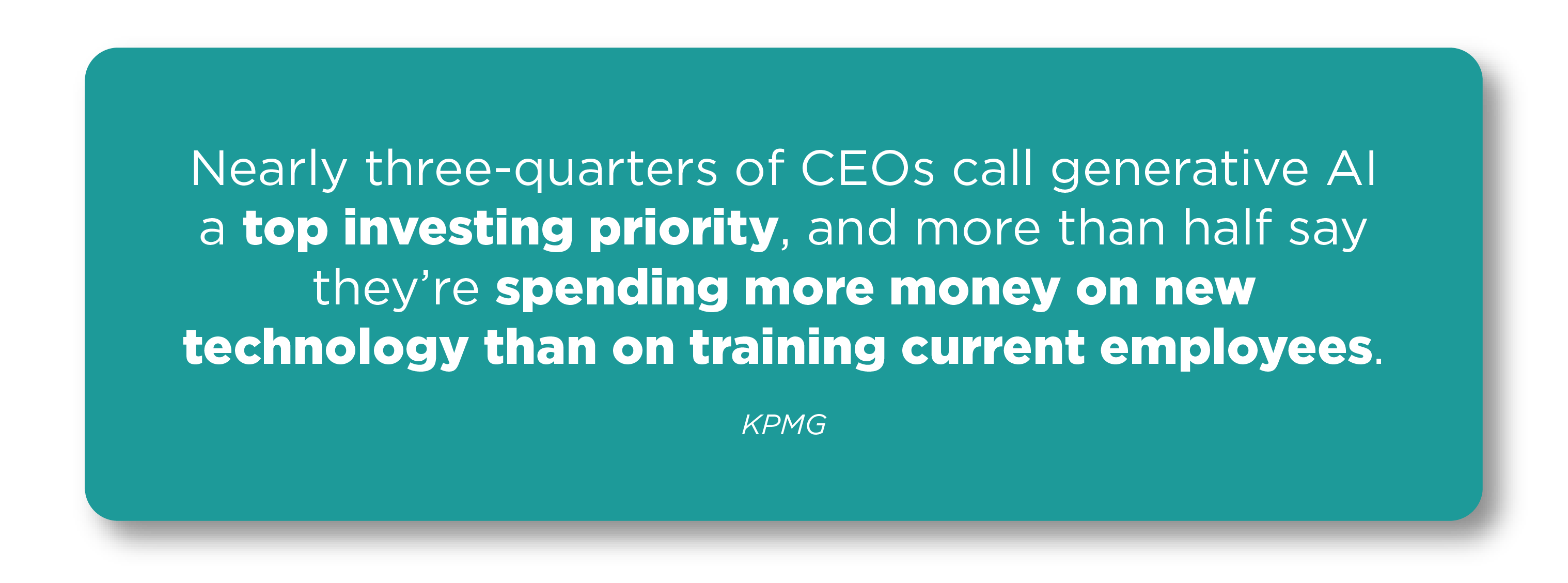 Leaders in many companies have been spending more on new technology than on training current team members [1]. While AI adoption may currently outpace people development, I predict a rebalancing is coming.
When leaders focus too much on tools and systems, and not enough on their human users, the result is often confusion, uneven adoption and anxiety, all of which create ripple effects that impact productivity and performance. Successful businesses will prioritize the growth of both their workforce and their technology.
As we continue our series on the 9 Learning & Development Priorities for 2026 [2], let’s explore how training professionals can best position their organizations by embracing the complementary nature of people and AI. [2]
[2]
Defining Human and AI Collaboration
Like teamwork between individuals [3], human-AI collaboration involves working together to achieve better outcomes than either could on their own. It’s not about a competition between staff and machines. Instead, it celebrates the idea that technology will enhance rather than replace human thinking, while delivering another avenue to unleash human creativity and potential.
Setting the Tone for Human-AI Collaboration
To create the conditions for successful partnerships between employees and artificial intelligence, leaders can lean on the principles that have consistently guided effective collaboration [3], including:
- Establishing shared goals
- Creating role clarity
- Maintaining transparent communication
- Cultivating trust and respect
 Establishing Shared Goals
It’s important to explain the purpose behind bringing people and machines together. Illustrate the benefits and articulate the desired outcomes leaders want to see as a result of pairing human judgment with AI systems. This step sets the foundation for greater alignment and establishes a vision for the future of work.
 Creating Role Clarity
Next, define what human workers are expected to contribute, what tasks AI will take on and where collaborative intelligence will shine. By setting boundaries for AI tools and clarifying the intersections between human skills and technological advancements, employees will gain a better understanding of how they fit into the organization in the long term.
 Maintaining Transparent Communication
As human-AI collaboration takes root, it’s essential to create multiple channels for feedback between employees, teams and leadership. Facilitate conversations to share best practices, raise concerns and identify opportunities to promote greater digital adoption and improve outcomes.
 Cultivating Trust
The future of work will benefit from human capabilities and machine intelligence. Be mindful to reinforce where human strengths are vital and where AI capabilities may be a better fit for certain tasks. By bringing awareness to strengths and blind spots, employees are more likely to embrace AI generated insights, question outputs when needed and use their own judgment when most appropriate.
How Learning & Development Can Drive Human-AI Collaboration
Often, companies integrate AI like they’re rolling out new software. In reality, it’s a cultural shift in the way we work. Learning & Development (L&D) professionals can support staff through this transition by focusing on those same four principles of effective teamwork.
Promoting Goal Achievement
Partner with executives to bring their vision for human-AI collaboration to life. As leaders define how employees and AI systems will work together, training professionals can develop the skills inventories that human workers will need to effectively use AI tools, cultivate the distinctly human intelligence that will set them apart and achieve the organization’s objectives.
With the inventories defined, L&D professionals can survey staff and analyze performance data to identify existing competency gaps that need to be closed to reach the business’s targets. They may also proactively prioritize and create learning paths for the most in-demand proficiencies.
Having concrete steps to train staff to succeed in an AI-driven world will help minimize anxiety and encourage employees to embrace the changes that come with new technologies.
Supporting Role Evolution
In addition to building digital literacy, employees need to elevate their uniquely human skills, such as discernment, communication and emotional intelligence.
L&D teams may develop training programs focused on effective decision-making by empowering people with capabilities like self-awareness while also educating staff on how to balance AI algorithms that often misunderstand nuance, complexity and volatility.
L&D professionals can boost communication skills by trainings personnel to contextualize AI outputs, while also learning to share information so that it connects to the different ways people prefer to receive it [4].
Lastly, a focus on relationship skills is vital. People are social creatures by nature, and our capacity to bring authentic empathy and EQ to the workplace is central to promoting belonging and motivation. Tools like Emergenetics can help you and your staff amplify soft skills [5].
Influencing Communication
To ensure personnel feel equipped to use collaborative intelligence, set up multiple feedback loops to measure employees’ confidence in needed skills and assess their performance as they incorporate new competencies into their work.
Additionally, L&D professionals can create learning groups to help teams provide feedback on AI integration initiatives. L&D can take an active role in this process by pairing learning programs with real AI pilot projects to gather data on the additional competencies and training that may be needed to effectively collaborate with technology.
Also consider hosting lunch-and-learns or knowledge-sharing sessions to encourage staff to discuss their AI adoption challenges, use cases and success stories. Through collaborative learning with their peers, employees will have a safe space to describe obstacles and get new ideas to better use AI systems.
Elevating Trust
Successful teams have confidence in one another, which means understanding where they each have strengths and weaknesses. [6] L&D practitioners play an important role in empowering people to know when to trust AI outputs and when to lean on their own cognitive processes. 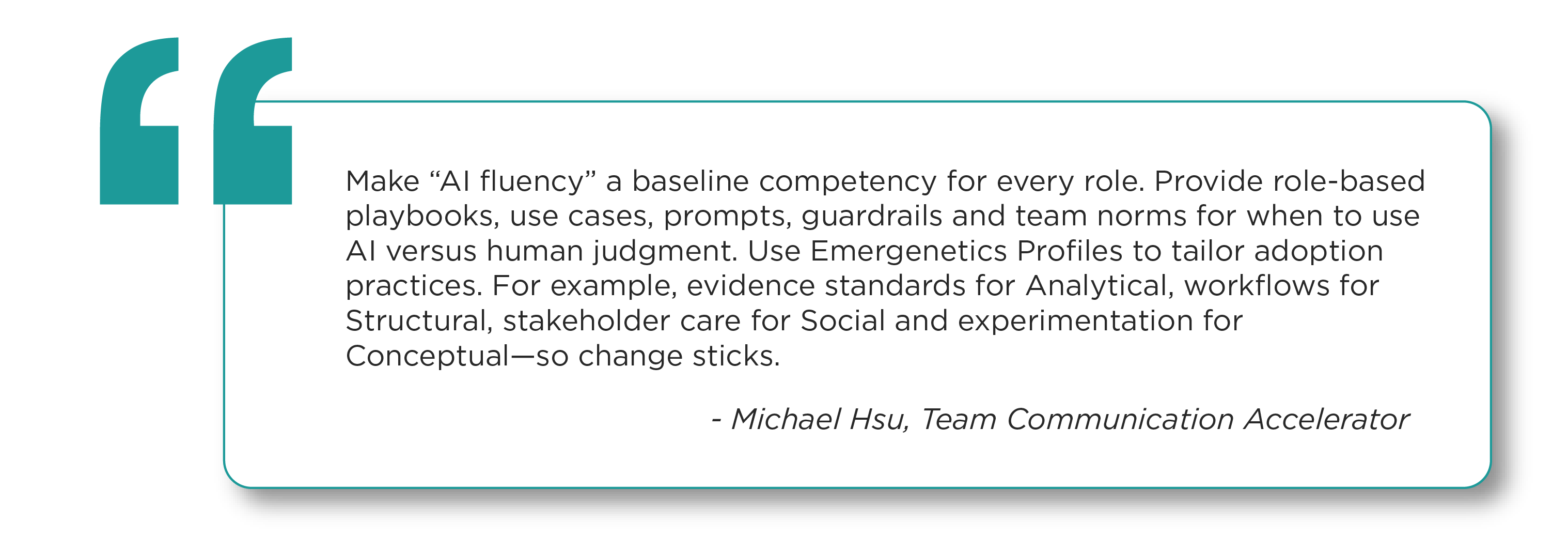 First, start with educating employees on AI bias and misinformation risks. By explaining the ethical concerns and potential for inaccuracies, employees will have a better understanding of how to use AI responsibly.
Second, emphasize ethical reasoning, critical thinking and judgment. These skills will be vital for effective human-AI collaboration. Training staff to be productive problem solvers, to question assumptions and consider alternative perspectives will help them benefit from AI-generated insights with needed human oversight.
Creating a Culture of Collaborative Intelligence
As you design a workplace that embraces technology and human insight, I’ll leave you with two questions.
First, how will you measure success?
Productivity is not just about how quickly work gets done. It’s about the outcomes produced. Consider how you will measure results like employee trust, improved decision quality and enhanced innovation.
Second, how will you celebrate your employees as they embrace new skills?
This next evolution in our workplace is significant. By rewarding curiosity, not perfection, and recognizing successes, you will build a thriving workplace that uses machine efficiency and human intelligence to unlock new possibilities.
Discover how Emergenetics can help your organization build trust, collaboration and cognitive readiness for the age of AI. Fill out the form below to connect with our team.
FAQs about Human-AI Collaboration
1. What is human and AI collaboration?
Collaboration between people and AI involves shared decision-making, where staff and machines contribute complementary strengths to achieve better outcomes than either could on their own.
2. How can organizations prepare employees to work with AI?
Companies can prepare staff by creating a shared vision of what human-AI collaboration looks like, as well as clarifying the roles that people and machines will take on. For example, AI may be best suited to support data processing and routine tasks, while humans are often better equipped to manage strategic thinking and reasoning in complex situations.
By upskilling staff with the necessary technical and soft skills, as well as carefully explaining the boundaries of human and AI collaboration, you will support workforce readiness.
3. What skills are needed for successful human-AI collaboration?
While some competencies will be role-dependent, all employees can benefit from building skills such as self-awareness, critical thinking, emotional intelligence, communication and discernment. Tools like Emergenetics [7] can help your staff develop these needed capabilities.
4. How does AI collaboration impact workplace culture?
An organization’s culture [8] will define whether AI feels empowering or threatening. Through transparent communication and creating a shared understanding of the roles people and technology will play in the workplace, you can create a positive, empowering environment.
5. What role should leaders play in AI adoption?
It’s essential for leaders to set the tone by establishing their vision for the future of work. Employees look up to their executives, so by modelling the way and practicing the behaviors they want to see in the workplace, leaders can also gain greater buy-in. It’s important to also invest in skill-building solutions like Emergenetics [9] to help executive improve the self-awareness, emotional intelligence and communication skills they will need to successfully lead their teams forward.